

If you searched does suppressing emotions cause memory loss, you are probably trying to make sense of something that feels scary and personal. You forget why you opened a tab. A name disappears mid-sentence. You walk into a room and your mind goes blank while your chest is tight and your jaw is locked. You are not chasing theory. You are trying to understand why your own mind feels less reliable by night, especially after a day of holding everything together. By the end of this guide, you will have one clear way to lower that fog tonight and a practical line between “stress pattern” and “get checked soon.”
Does Suppressing Emotions Cause Memory Loss is not proof something is wrong with you, but a sign your body and inner life have been carrying too much alone.
Emotional suppression can make memory feel worse, sometimes dramatically worse, without meaning your brain is permanently damaged. When your system is busy holding back tears, anger, fear, or grief, it burns fuel on control. Attention drops. Encoding weakens. Recall gets patchy. Your mind is not betraying you; it is overloaded by protection. Shame says “something is wrong with me.” A steadier frame is “something in me has been working too hard for too long.”
If you want wider context first, read our Permission to Feel guide, then come back here.
The short answer you came for
Join our insider list
Get exclusive insights delivered to your inbox — plus a free guide when it drops.

Yes. **Emotional suppression effects** can include forgetfulness, concentration problems, and mental fog.
The common pattern is uneven: you blank in conversations, lose track of simple tasks, reread the same line, or forget what you just decided. It often gets worse after conflict, emotional shutdown, poor sleep, or long stretches of “I’m fine” performance. It often improves when emotional load drops and sleep improves.
That pattern matters. Suppression-related fog usually comes in waves. Serious neurological disease more often shows steady progression, major functional decline, or additional red-flag symptoms.
Evidence from emotion-regulation and stress research supports this mechanism: suppressing emotion increases cognitive load in the moment, while ongoing stress and sleep disruption reduce memory consolidation (emotion regulation, cortisol, memory).
Important safety boundary: seek medical care promptly if symptoms are sudden, rapidly worsening, or paired with confusion, fainting, blackouts, head injury, language changes, new neurological symptoms, medication changes, or clear day-to-day decline.
Why memory fog happens when you keep everything contained

Memory is not one fixed ability. It is a living loop: noticing, storing, and finding information again when you need it.
Suppression strains that loop.
When you are managing tone, face, words, and reactions all day, part of your attention is spent on control instead of contact. You look present, but your mind is split between the room and the effort to stay contained.
When your body is braced, safety takes priority over detail. You track risk faster than specifics. Information passes through, but less of it sticks.
Later, retrieval feels personal: I know this. Why can’t I get to it? Most of the time, that moment is load, not loss of intelligence.
Most people feel this in the body before they can explain it: tight throat, heavy chest, locked jaw, raised shoulders, knotted stomach, numb or restless hands. These are not random symptoms. They are the cost of staying contained for too long.
Then sleep gets involved. Unfelt emotion returns at night as rumination, early waking, or shallow sleep. Poor sleep worsens consolidation. The next day is foggier. Then self-criticism gets louder. Fog plus shame becomes its own exhausting loop.
This is why the better question is not “What’s wrong with me?”
The better question is “How much internal load am I carrying right now?”
If does suppressing emotions cause memory loss still feels heavy in your body right now, Feeling.app is a calmer way to stay with what you feel.
A calmer, steadier way to meet what you feel — without bypassing, forcing, or performing recovery.
The pattern underneath: “If I feel this, I lose connection”

For many of us, suppression started as protection.
Sadness was ignored. Anger was punished. Need felt dangerous. So we learned the mask: helpful, calm, capable, low-maintenance. That adaptation may have preserved belonging once. Today, it often drains cognitive capacity in quiet, daily ways.
Under the memory question, there is often a relationship question:
“Is it safe to be real here?”
When the answer feels like no, your system pays for the split between outer behavior and inner truth. That split is expensive, and it adds up.
From the outside, it can look like simple forgetfulness. From the inside, it often feels like living as your own observer instead of your own person: watching yourself perform while your real reactions stay locked in your throat, chest, and gut.
This is why permission to grieve can sharpen clarity, not just deepen emotion. Grief includes death, yes, but also unsaid words, unmet needs, and years of swallowing what hurt. What has no witness often hardens into numbness. Numbness can look stable from the outside while the inside keeps spending energy to stay shut.
This also explains part of the men and emotions dilemma. Many men were taught that vulnerable feeling risks status, love, or safety. So pain gets converted into silence, overwork, irritability, or shutdown. Different people are trained differently, but the mechanism is similar: what cannot be safely felt gets carried, and carrying has cognitive cost.
And yes, letting yourself cry can help. Not as a performance. Not on command. As honest emotional release that lowers internal pressure so attention can return.
If you want to keep going after this article, read why we say “I’m fine” when we’re not, how to stop hiding your feelings, and what emotional numbness is really protecting.
What helps memory clear without forcing yourself harder
More control is usually not the cure, because suppression is already overcontrol.
What helps is reducing load in repeatable ways:
Keep one daily window where you do not perform for anyone.. Name sensation before story: throat, chest, stomach, jaw, shoulders, hands.. Protect sleep like treatment, not luxury.. Reduce optional overload on depleted days.. Let one safe person witness you without fixing you..
A simple clue: if memory gets worse after emotional shutdown and better after honest contact plus better sleep, suppression is likely part of your pattern. That turns fear into a plan.
A 10-minute practice for tonight: contact without collapse
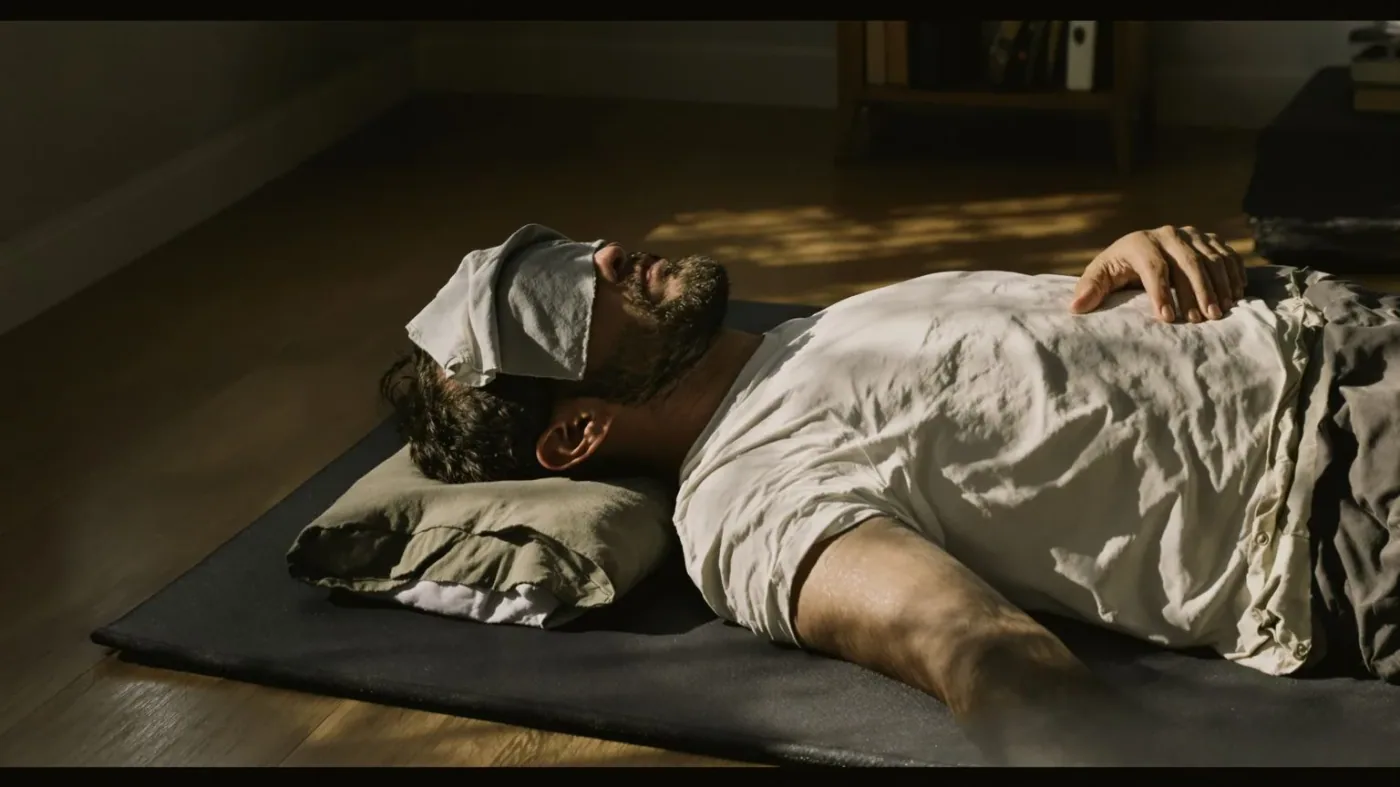
Do this once tonight exactly as written.
Permission (30 seconds)
You do not need to solve your life tonight.
You only need one honest moment your body can trust.
Entry (1 minute)
Lie down on a stable surface.
Place your hands beside your hips, palms facing down.
Close your eyes, or cover them gently with a shirt or scarf.
Keep your body still.
No swaying. No rocking. No stretching.
Body location (5 minutes)
Bring attention to the strongest sensation right now.
Not the story. The sensation.
Choose one location:
- throat
- chest
- stomach
- jaw
- shoulders
- hands
Stay with one spot only.
When your mind runs, return to that spot.
Tolerance (2 minutes)
If intensity rises, lower the dose without leaving.
- Move attention to the edges of the sensation.
- Lengthen your exhale slightly.
- Say quietly: “I can stay for one more breath.”
If tears come, let them come.
If nothing comes, nothing is wrong.
One quiet truth + integration (1.5 minutes)
Keep eyes closed. Notice one shift: pressure, breath depth, temperature, jaw tension, urge to cry, or a little more space.
Say one sentence out loud:
- “This is what I’m carrying.”
- “I don’t need to hide this from myself.”
- “I can feel this and stay.”
Then write one line before sleep:
“Before this, my mind felt ___. After this, my mind feels ___.”
That line becomes your baseline.
What changes after a week of this practice

What changed: you start catching the shutdown earlier, before it takes the whole day. You hold details a little longer. You recover faster after stress spikes.
What softened: the fear spiral around forgetfulness. Instead of “my brain is failing,” you can often see “my system is overloaded,” and that change in framing reduces panic load immediately.
What becomes clearer: when you stop spending so much energy on emotional containment, more of that energy returns to attention, recall, and steadiness in ordinary moments.
What remains true: if symptoms are sudden, progressive, or include neurological red flags, you still need medical care. Emotional load explains a lot, but it should not be used to ignore warning signs.
Try tonight’s 10-minute practice, track one before/after sentence for seven days, and watch for pattern clarity. Keep the core truth close: your mind is not betraying you; it is overloaded by protection. Say it in plain language when fear rises: the fog is not proof that you are broken, it is proof that you have been carrying too much alone.
You do not have to fight does suppressing emotions cause memory loss by force, but you can meet it with honesty, gentleness, and one true next step.
What often changes first is not the whole story, but the amount of force inside it. When does suppressing emotions cause memory loss is named honestly, your body usually stops wasting so much energy on hiding, bracing, and pretending to be fine. That is where clarity begins. You may notice a little less pressure in your chest, a little more room in your breathing, or a little less panic around what this means about you. Those are not small things. They are signs that truth is starting to replace performance. And when truth returns, you can choose what actually restores you instead of repeating what only keeps you depleted.
What often changes first is not the whole story, but the amount of force inside it. When does suppressing emotions cause memory loss is named honestly, your body usually stops wasting so much energy on hiding, bracing, and pretending to be fine. That is where clarity begins. You may notice a little less pressure in your chest, a little more room in your breathing, or a little less panic around what this means about you. Those are not small things. They are signs that truth is starting to replace performance. And when truth returns, you can choose what actually restores you instead of repeating what only keeps you depleted.
You do not have to fight does suppressing emotions cause memory loss by force, but you can meet it with honesty, gentleness, and one true next step.
If you want a gentler way to continue after this article, Feeling.app is worth trying.
A calmer, steadier way to meet what you feel — without bypassing, forcing, or performing recovery.
Frequently Asked Questions
Can bottling up emotions actually make me more forgetful?
Yes, bottling emotions can make your memory feel weaker in daily life. If you keep swallowing anger, grief, or fear, your body spends energy holding your throat tight, your chest guarded, and your jaw clenched instead of laying down clear memories. That is why names, appointments, or parts of conversations can vanish when you are “fine” on the outside but bracing on the inside. When people ask does suppressing emotions cause memory loss, we usually see more fog and fragmentation than true erasure. Start small: place a hand on your chest, name one feeling honestly, and give your mind less to hide and more to remember.
Why do I forget parts of arguments when I stay calm and say nothing?
Yes, it is common to forget parts of hard conversations when you shut your feelings down to get through them. In the moment, your body may go numb in your hands, tight in your stomach, and distant in your chest, and attention narrows to survival rather than detail. Later, it can feel scary, like your mind betrayed you, but often your system was protecting you from overload. The question does suppressing emotions cause memory loss comes up here because emotional shutdown can block full encoding of what happened. After conflict, take three quiet minutes to breathe with palms down and write what your body felt first, then what was said.
If I have suppressed feelings for years, is the memory damage permanent?
Usually no, this kind of memory trouble is not permanent. When emotions have been pushed down for years, your shoulders stay high and your stomach stays knotted, and memory can feel like it is stuck behind a locked door. As safety grows and you stop performing okay, many details return in pieces, along with clearer focus in daily life. So when you ask does suppressing emotions cause memory loss, think less of a broken mind and more of a mind that went into hiding to protect you. Give yourself permission to recover slowly, because one honest check-in each day can open more space than forcing everything at once.
Can unspoken grief make me lose chunks of time?
Yes, unspoken grief can create blank spells where hours blur together. When your chest is carrying old sadness and your throat keeps swallowing tears, your mind may detach just enough to keep functioning, but not enough to store a clear timeline. That can feel like losing pieces of yourself, especially at night when the house is quiet and the heaviness gets louder. If you are wondering does suppressing emotions cause memory loss, this is one common way it shows up: not total forgetting, but missing chunks around painful moments. Try speaking one unsent sentence out loud tonight—“this hurt me”—and notice whether your memory feels more grounded afterward.
How can I stop suppressing feelings so my memory gets better?
You can improve memory by reducing emotional suppression, even if you start very small. Each time you pause and name what is in your body—tight throat, heavy chest, twisting stomach—you free attention that was spent on holding everything in. Over time, this creates more mental space for names, tasks, and conversations to stick. People searching does suppressing emotions cause memory loss are often relieved to learn the mind sharpens as the mask softens. For one week, set a nightly five-minute check-in with eyes closed, palms down, and write three words for what you feel, because consistency matters more than intensity.