

You searched for somatic grounding techniques because you need guidance you can trust, not another list that disappears the second panic spikes. When your chest tightens at night, when your throat closes mid-conversation, when your stomach drops for no clear reason, confusion can feel brutal: Is this anxiety? trauma? stress? Am I doing this wrong?
Somatic Grounding Techniques is not proof something is wrong with you, but a sign your body and inner life have been carrying too much alone.
If you are reading this at the end of a long day, still holding yourself together while your body stays on high alert, that makes sense. These somatic grounding techniques are for that exact moment: when words are thin, your jaw is tight, and you need one clear next step that does not ask you to pretend.
Somatic grounding techniques are not proof something is wrong with you, but a sign your body and inner life have been carrying too much alone.
You are not doing it wrong. By the end of this guide, what to do next will feel clearer, and the fear around the sensation will usually soften.
Your body is not the problem; your body is the messenger.
The core turn is this: a body reaction is not proof you are broken. It is information arriving faster than words. Shame says, “Why can’t I just calm down?” Clarity says, “My system is in a state, and states need matched responses.”
That is what this guide gives you: one practical path. We will name what state you are in, match the right kind of grounding, and walk one short practice you can use today. Not performative calm. Not self-analysis spirals. Just clear steps your nervous system can actually use in real life.
For broader context, start with our Body & Nervous System guide.
“When your mind says ‘I’m fine’ and your chest says ‘I can’t breathe,’ the chest is the honest voice.”
When grounding fails, it is usually a mismatch, not a personal failure
Join our insider list
Get exclusive insights delivered to your inbox — plus a free guide when it drops.

Most people are taught one generic rule: “Just ground yourself.” Then they try it, feel worse, and assume they failed.
What usually failed was fit.
If your system is flooded, reflective techniques can feel unreachable. If your system is numb, intense activation can feel invasive. If shame spikes after conflict, complex exercises can add pressure you cannot carry. The method has to match the state you are actually in, and state-matched somatic grounding techniques usually work faster than generic routines.
A second mismatch is the hidden goal. Control sounds like: Make this stop immediately. Safety sounds like: This can be here, and we are still here too. Control tightens the body. Safety gives it room to downshift.
A third mismatch is pace. Many nervous systems need titration, not intensity. Small contact. Short pause. Return. That rhythm builds trust faster than forcing a breakthrough.
This is why window of tolerance matters. Inside your window, you can feel and think at the same time. Above it, you flood. Below it, you shut down or go flat. Learn the full framework here: window of tolerance explained in plain language.
When you are outside your window, do one precise move:
If you are racing: reduce sensory input and track one body point only.
If you are numb: feel contact (back on surface, legs on floor, palms down, weight in hands).
If shame is spiking: name one body fact, not your whole story (“My jaw is hard.” “My throat is tight.”).
If internal focus is too much: orient outward (one thing you see, one thing you hear, one sensation on skin, one taste).
If escalation is sharp: brief cold cue (ice in hand for 10–20 seconds), then return to body contact.
For medical context, the APA overview on stress and the body is useful.
“We do not heal by arguing with the alarm. We heal by teaching the alarm what safety feels like.”
If somatic grounding techniques still feel heavy in your body right now, Feeling.app is a calmer way to stay with what you feel.
A calmer, steadier way to meet what you feel — without bypassing, forcing, or performing recovery.
Your symptoms are signals, and signals can be read
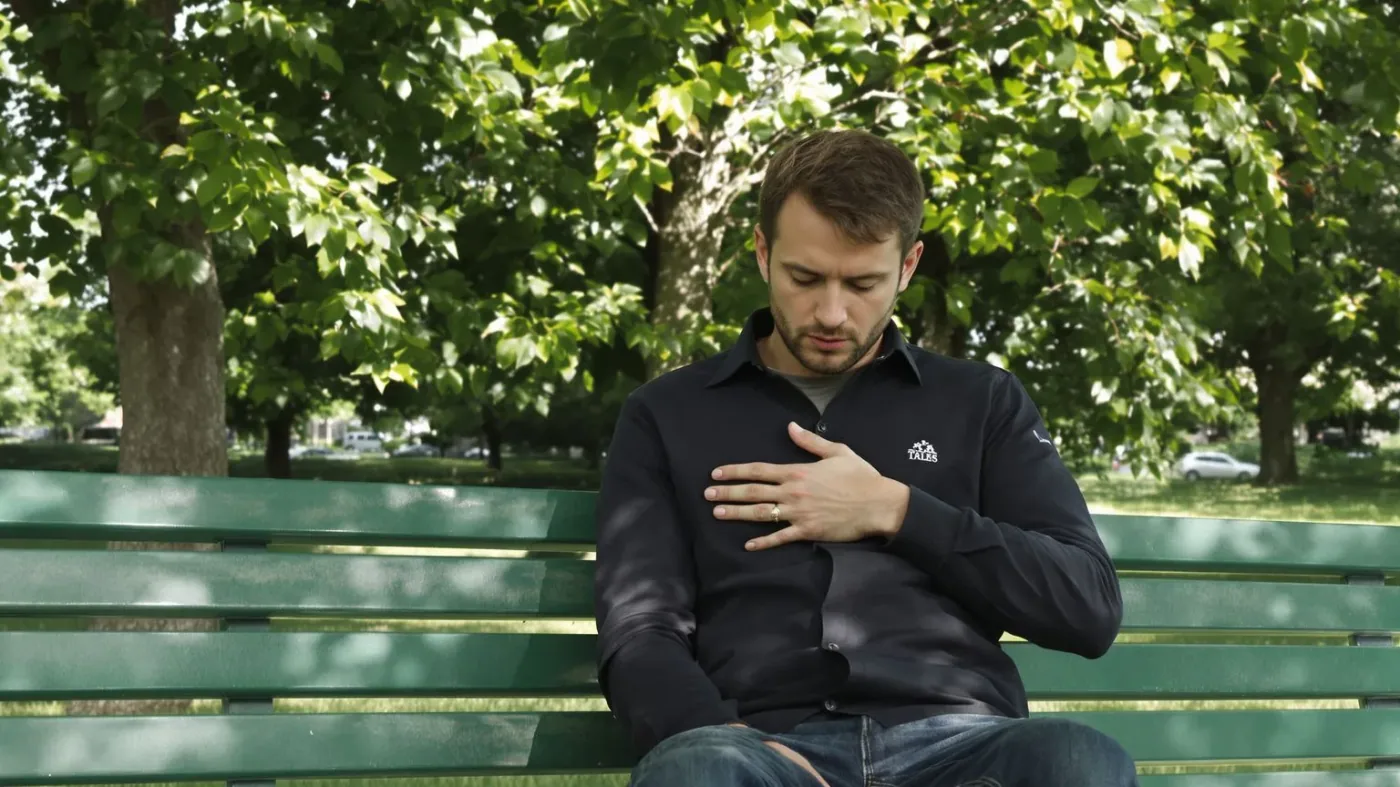
The question is rarely “What is the best grounding technique?”
The better question is “What is my body saying right now?”
A throat can hold unsaid words.
A chest can hold grief nobody witnessed.
A stomach can hold fear before your mind can explain it.
Shoulders and jaw often hold over-control.
Hands often hold helplessness.
This is felt sense: body knowing before language. Eugene Gendlin’s Focusing work points to this directly. What many people call The Body Keeps the Score is often this lived pattern: what was never safely processed keeps speaking through sensation.
You can see this in ordinary moments: standing at the sink after an argument, everything quiet, but your jaw is locked and your breath is high. Nothing dramatic is happening. Your body is still finishing what your day did to it.
A useful observer layer starts here: notice the first sentence your mind adds to the sensation. Is it “I am failing again,” or “Something in me needs contact”? That moment changes whether you escalate or settle.
The practical truth is non-negotiable: the symptom is not the enemy. It is the doorway.
If we attack the signal, fear usually grows.
If we witness the signal precisely, fear usually softens.
That is embodiment in plain life. Sensation first. Story later. This is where somatic grounding techniques become less like a trick and more like a relationship with your own body.
Why this works when “thinking positive” does not

Your nervous system scans for danger continuously. It uses memory, context, tone, and body cues before conscious thought catches up. So when your reaction feels “too much,” it is usually “too fast,” not fake.
A common chain looks like this:
- Trigger (tone, silence, conflict, uncertainty).
- Body response (pressure, heat, collapse, numbness, urgency).
- Meaning story (“I’m too much,” “I’m failing,” “I’m alone”).
- Behavior (people-pleasing, shutting down, over-explaining, disappearing).
Most strategies try to fix step 3.
Somatic grounding works at step 2, while the pattern is still movable.
That is a real nervous system reset: not deleting your history, not pretending calm, but giving the stress loop enough safety to complete so choice comes back. Practiced this way, somatic grounding techniques help you interrupt the spiral before shame takes over.
Breath can help, but it is not a performance test. Natural breathing plus clear body contact is often enough to begin.
One reframe changes the outcome:
not “How do we stop this?”
but “Where is it, and can we stay with it 20 seconds longer than usual?”
Those extra seconds are often where panic starts becoming presence.
For added background, see the NIMH stress overview and body-based material such as Somatic Experiencing.
If numbness is your default, that is also protective, not proof of failure. Read: why emotional numbness happens and how to reconnect safely.
If “I’m fine” is automatic, read: how to stop saying I’m fine when you’re not.
A 12-minute somatic grounding practice for today

Do this once today. Exactly as written.
If you do only one thing from this article, do this practice.
0:00–1:00 — Permission
Before anything else, silently say:
“I do not have to fix this right now. I only have to stay.”
That sentence lowers pressure. Pressure blocks contact. Contact creates change.
1:00–2:00 — Entry
Lie down on a stable surface.
Hands beside hips, palms down.
Eyes closed or gently covered.
Keep your body still.
Let the floor do the holding.
2:00–4:00 — Body location
Ask: “Where is the strongest signal?”
Choose one area only: throat, chest, stomach, jaw, shoulders, or hands.
Use plain words: tight, heavy, hot, hollow, buzzing, numb, pressed.
One place. One language. Nothing abstract.
4:00–7:00 — Tolerance
Rest attention there for three minutes.
If intensity spikes, widen attention to include contact with the floor.
If you drift into thoughts, return to sensation.
You are not trying to go deeper.
You are practicing staying.
7:00–9:00 — One quiet truth
Say one witnessing line internally to that body area:
- “You are allowed to be here.”
- “We are listening.”
- “You do not have to hide right now.”
Repeat gently. No forcing.
9:00–11:00 — Integration
Ask: “What shifted by 5%?”
Maybe pressure eased.
Maybe fear dropped while sensation stayed.
Maybe your hands feel warmer.
Maybe nothing obvious changed except you stayed.
Staying is a change.
11:00–12:00 — Next action
Keep natural breathing.
Feel your back, legs, and palms supported.
Open eyes slowly. Sit up slowly.
Write one line:
“Right now, my body feels ___, and the next kind action is ___.”
That is enough for today.
If you want a gentler way to continue after this article, Feeling.app is worth trying.
A calmer, steadier way to meet what you feel — without bypassing, forcing, or performing recovery.
What changes after practice — and what does not

What changed: you now have a sequence you can trust when the wave hits.
What softened: the panic around the sensation, even if the sensation itself did not fully disappear.
What remains true: your body is not working against you; it is signaling clearly and asking for a matched response.
The first shift is rarely “all symptoms gone.”
The first shift is usually “less fear of the symptoms.”
That threshold matters. What was chaos becomes readable. What was shame becomes information. What felt like personal failure becomes a state with a clear response.
Over time, three things usually soften:
- the panic that follows sensation,
- the time it takes to come back,
- the urge to abandon yourself when intensity rises.
And one truth remains: your body is not an obstacle to healing. It is the way in.
If your patterns include persistent trauma symptoms, flashbacks, or heavy depression, professional support can be an important next layer. This article is educational support, not medical care.
The path is clearer than it feels at 2 a.m.
One signal. One witness sentence. One kind next action.
You do not need to be fearless to come back to yourself. You only need a method you can trust when the wave hits.
You do not have to fight somatic grounding techniques by force, but you can meet it with honesty, gentleness, and one true next step.
What often changes first is not the whole story, but the amount of force inside it. When somatic grounding techniques are named honestly, your body usually stops wasting so much energy on hiding, bracing, and pretending to be fine. That is where clarity begins. You may notice a little less pressure in your chest, a little more room in your breathing, or a little less panic around what this means about you. Those are not small things. They are signs that truth is starting to replace performance. And when truth returns, you can choose what actually restores you instead of repeating what only keeps you depleted.
What often changes first is not the whole story, but the amount of force inside it. When somatic grounding techniques are practiced with less force and more honesty, your system learns that sensation can be felt without collapse. That is where trust starts to come back. A little less bracing. A little less pretending. A little more room to stay with yourself when the wave rises.
Your body is not the problem; your body is the messenger.
That is why these somatic grounding techniques matter: they help you hear the message, meet it safely, and come back to yourself without abandoning what is true.
You do not have to fight somatic grounding techniques by force, but you can meet it with honesty, gentleness, and one true next step.
What often changes first is not the whole story, but the amount of force inside it. When somatic grounding techniques is named honestly, your body usually stops wasting so much energy on hiding, bracing, and pretending to be fine. That is where clarity begins. You may notice a little less pressure in your chest, a little more room in your breathing, or a little less panic around what this means about you. Those are not small things. They are signs that truth is starting to replace performance. And when truth returns, you can choose what actually restores you instead of repeating what only keeps you depleted.
Frequently Asked Questions
Why do I feel overwhelmed even when I know I’m safe?
Because conscious understanding and body state are not the same process. Your mind can know the present is safe while your nervous system is still running an older alarm pattern. Somatic grounding works by meeting the body layer first, so your system can update in real time.
What are the most effective somatic grounding techniques for anxiety?
The most effective techniques are state-matched. When flooded, reduce input and narrow to one sensation point. When numb, increase contact cues (palms down, back supported, weight through legs). Short, consistent sessions usually create more reliable change than occasional intense sessions.
How do I use grounding when I feel emotionally numb?
Start with contact, not emotion labels. Feel where your body meets the surface. Track pressure, temperature, and weight. Numbness is still a signal, often protective. Gentle repetition helps sensation return without overwhelm.
How long should a grounding practice take?
Two to twelve minutes is enough for most moments. The goal is not perfect calm. The goal is measurable return of presence and choice, even a 5% shift.
Is the 5-4-3-2-1 method the same as somatic grounding?
It is one useful grounding tool, especially for orienting outward. Somatic grounding is broader: it also includes direct tracking of internal body signals and staying with them safely until they become more workable.
Why do grounding techniques sometimes make me feel worse at first?
When you slow down, signals you were suppressing can become more noticeable. That can feel worse even when processing has started. If intensity rises too far, shorten the session, focus on external contact, and pause when needed. Gradual pacing protects trust.